

Problem library
Garage Door Won't Close
When a door refuses to finish closing, it is usually obeying a safety system rather than failing. The trick is reading which system stopped it: the photo eyes, an obstruction, the travel limits, or the wall control.
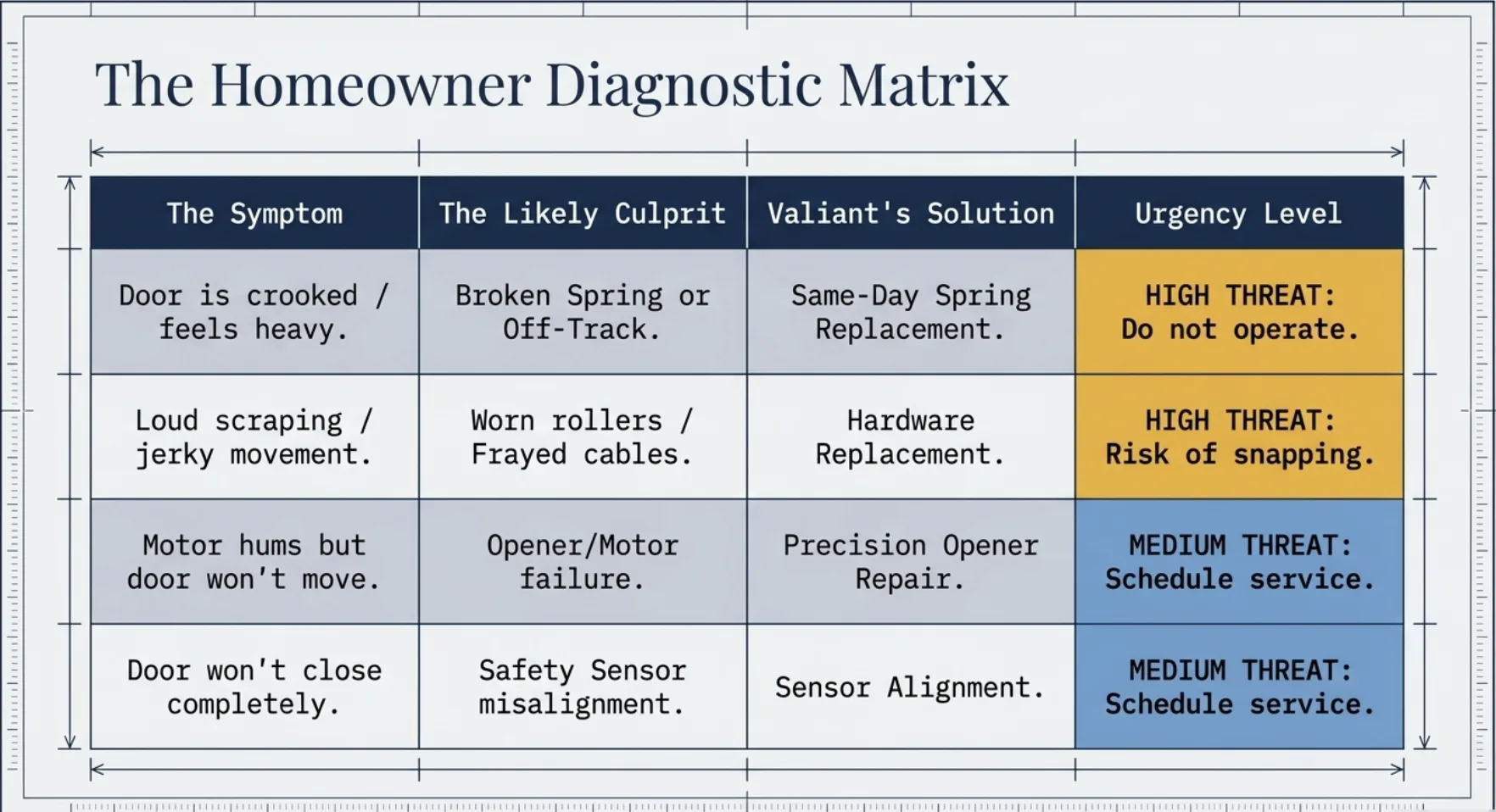
Read The Behavior Before Touching Anything
How the door refuses to close tells you most of what you need to know. Note exactly where it stops and what happens next.
- Starts down, reverses immediately, opener light blinks: photo eye beam is broken or misaligned.
- Starts down, reverses at the same spot every time: an obstruction or a binding roller at that point in the track.
- Reaches the floor, then rolls back up: down travel limit or force setting.
- Will not move at all from the remote or wall button: lock mode, power, or a control fault.
- Closes only if you hold the wall button: the opener is refusing under its own safety logic.
Photo Eyes: The Number One Reason
Two small sensors sit near the floor on both sides of the opening, roughly four to six inches up. One sends an invisible beam, the other receives it. Break that beam and the opener will not close under power. That behavior is required by federal safety rules, and it is the system doing its job.
Look at the LEDs. A steady light on both usually means the pair is aligned. A dark or flickering light on the receiving side means it cannot see its partner. Common culprits are a bumped bracket, a spider web, road dust on the lens, or a bike leaning in the beam path.
Wipe both lenses with a dry cloth, clear the floor from wall to wall, and try again. If the LED still will not settle, the alignment or wiring needs attention. Our sensor troubleshooting guide walks through the LED patterns in more detail.
Afternoon Sun Is A Real Cause
West-facing garages in Pleasanton and Livermore get hit hard by low sun in the late afternoon. Direct sunlight into the receiving eye can overwhelm the beam, so the door closes fine all morning and refuses at five o'clock.
If your problem keeps a schedule, sun is the first suspect. A small shade, a sun tube, or rotating the sensor a few degrees away from the glare is the usual repair, not a new opener.
Obstructions You Would Not Think To Look For
Physical interference does not have to be dramatic. Check for a raised threshold strip, a bag of soil against the jamb, a hardened bottom seal, salt or gravel in the floor channel, or a storage bin edge just inside the track line.
Then look at the tracks themselves. A dented rail, a loose lag bolt, or a flat-spotted roller can bind the door at a fixed height and make the opener read it as an obstacle. If the door binds at the same inch every time, the track is telling you where to look.
Travel Limits And Force Settings
| Symptom | Setting involved | Who should adjust it |
|---|---|---|
| Door hits floor and reverses | Down travel set too far | Technician, or a confident owner following the manual |
| Door stops a few inches short | Down travel set too shallow | Same |
| Door reverses part-way, no light blink | Down force too low for a binding door | Technician: find the bind first |
| Door slams closed hard | Force set too high or door out of balance | Technician, treat as urgent |
One caution about force settings: raising the down force to overpower a stiff door removes the protection that stops the door on a person or a pet. If the door needs extra force, the mechanical problem needs fixing instead.
What The Wall Control Is Telling You
Modern wall panels carry a lock button. When lock mode is on, the opener ignores remotes and keypads while the wall button still works. Many puzzling no-close calls are a lock button pressed by a kid or a bumped elbow. Hold the lock button until the indicator stops flashing.
If the wall button does nothing either, check that the opener has power and that the low-voltage wires at the terminal screws are still seated. A stapled-through wire behind drywall is a real failure mode in older garages.
Test The Safety Reverse Once It Closes Again
After any repair, prove the safety systems work. Lay a two-by-four flat on the floor in the door's path and press close. The door should touch the wood and reverse. Then wave a broom handle through the photo eye beam mid-close. The door should reverse there too.
If either test fails, the door is not safe to use around children or vehicles, even though it moves. Book safety sensor service rather than living with it.
Securing A Door That Will Not Close Tonight
An open garage is an open door to the house. If the fix has to wait, pull the vehicle out or lock the interior door to the house, remove valuables from reach, and if the opener will hold the door down with constant pressure, close it and unplug the unit so nothing reopens it by remote.
Then describe the behavior when you book: where it stops, whether a light blinks, and what time of day it happens. That detail decides whether we arrive with sensors, rollers, or opener parts.
Helpful Valiant Pages
Common Questions About Doors That Will Not Close
Why does my door reverse right before it touches the floor?
Either the down travel limit is set too far, so the opener senses resistance at the floor, or something under the door such as a threshold seal or a piece of gravel is being contacted. Both show up at the same point in the cycle every time.
Why does the door close fine at night but not in the afternoon?
Low sun shining directly into the receiving photo eye washes out the beam. Shading the eye or repositioning it slightly usually solves it, and the timing of the problem is the clue.
What does one blinking light on the opener mean?
On most units a blinking opener light or a blinking sensor LED means the safety beam is broken or misaligned. The opener will not close under power until it sees a clean beam.
Can I hold the wall button to force the door down?
Some openers allow a constant-pressure override, but it bypasses the safety reverse. Do not use it as a routine workaround, and never use it when anyone is near the opening.
Ready For A Clear Next Step?
Call (925) 409-4974, request an appointment, or start an instant estimate with photos.