

Problem library
Garage Door Won't Open
A door that will not open is either an opener problem or a lifting problem. Telling those two apart in the first minute is what keeps a small repair from turning into a bent-panel repair.
First Minute: Watch What The Door Actually Does
Press the wall button one time and watch closely. Does the motor run? Does the door lift an inch and drop back? Does nothing happen at all? Each answer points in a different direction.
Press it once, not five times. A door that cannot lift will not lift on the sixth try. What it will do is strip the opener gear or pull a bracket out of the header.
Signs The Opener Or Its Power Is At Fault
These causes are the least dangerous and the easiest to rule out from the floor:
- Motor silent and the light will not come on: check the outlet, the breaker, and any GFCI in the garage.
- Remotes dead but the wall button works: usually remote batteries or a lost radio code.
- Motor hums or grinds and the chain never moves: often a stripped drive gear.
- Chain moves but the door sits still: the trolley is unhooked from the door arm.
- Every remote quit at once and the wall panel shows a lock symbol: lock mode is probably on.
Battery swaps, breaker resets, and unplugging the unit for thirty seconds are all reasonable homeowner steps. Anything holding tension is not.
Signs The Counterbalance Failed Instead
The springs above your door carry nearly all of its weight. The opener only guides a door that is already balanced. When a spring breaks, the motor suddenly faces the whole load and quits.
Look for a bang you heard earlier in the day, a visible gap in the coiled torsion spring, a cable hanging slack or coiled on the floor, or a door that sits lower on one side. Any of those means the lifting system failed, not the motor.
A new opener will not solve this, and another button press can drag the door out of alignment. That work belongs to spring replacement or cable repair.
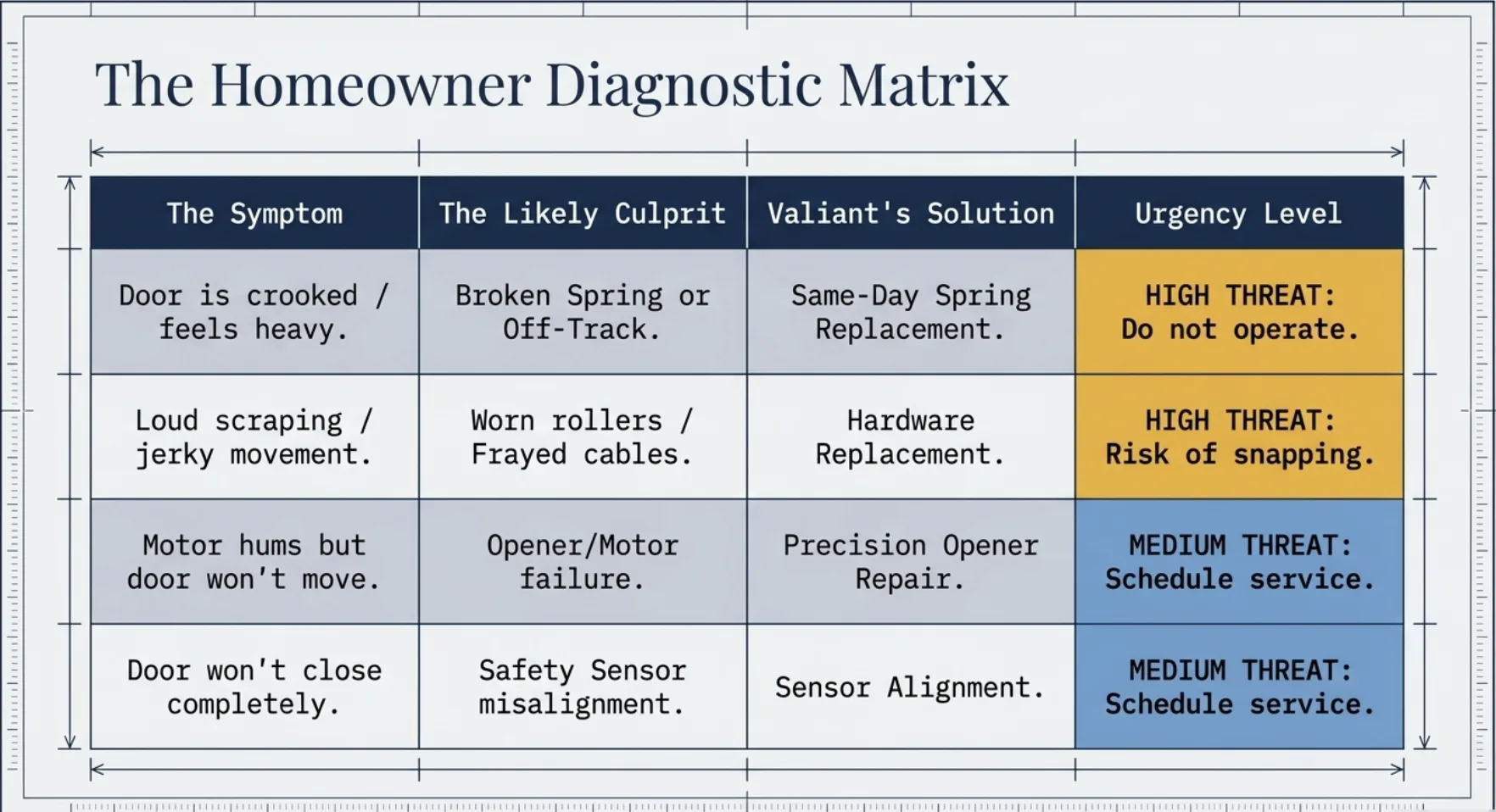
Match What You See To The Likely Cause
| What you see or hear | Likely cause | Homeowner step? |
|---|---|---|
| No sound, no lights | No power reaching the unit | Yes: breaker, outlet, GFCI |
| One click, then nothing | Seized motor or engaged lock | No |
| Motor runs, chain moves, door still | Trolley disconnected | Yes, with the door closed |
| Lifts two inches, reverses | Broken spring or load fault | No |
| Lifts crooked, one corner stays down | Broken cable or slipped drum | No |
| Grinding inside the motor head | Stripped nylon gear | No |
What The Red Release Cord Can And Cannot Do
That cord separates the door from the opener so the door can be moved by hand. It is genuinely useful during a power outage on a balanced door.
It is not a fix for a broken spring. Once the door is disconnected, the springs are the only thing holding the weight, and if they are gone the door can drop fast. Never pull the cord while the door is stopped part-way up, and never reach for it from under a raised door.
If a healthy door has to be closed by hand, use two people, keep hands flat on the panel face, and keep fingers away from the joints between sections.
Stuck Closed With The Car Inside
This is the most common version of the call, and the urge to force something is strong. Lower the pressure first: is there a side door, and is the vehicle needed in the next hour?
If it is, say that when you call. A trapped vehicle changes how the day gets routed. Same-day help is frequently possible when a technician, the route, and the right parts line up, but it is never a promise.
Leave The Door Alone If You See Any Of This
- A torsion spring with a visible break, or a stretched extension spring hanging loose.
- Slack, frayed, or unwound cable on either side of the opening.
- A door sitting crooked in the frame, or a roller sitting outside its track.
- A burning smell from the motor head. Unplug it and stop there.
Every item on that list involves either stored energy or a door that is no longer square in its opening. Both get worse with one more cycle.
What We Check On A No-Open Call
The visit starts with one test: can the door be raised by hand at all? From there we look at spring condition and sizing, cable wrap on both drums, roller and hinge wear, track alignment at the header, opener travel and force limits, and the safety reverse.
Valiant is a small, founder-led shop and we lean repair-first. If a spring gets your door working properly, we say so instead of selling you a motor. If the opener has been fighting dead weight for weeks, we tell you that too, because that wear is real.
Where To Go Next
Questions We Hear On No-Open Calls
Why does my opener run but the door stay still?
The trolley is almost always disconnected from the door arm. That happens after someone pulls the red release cord. With the door fully closed, most openers reconnect when you pull the cord toward the door and run the motor until the trolley clicks back in.
My door lifts two inches and drops back. What is that?
That is the classic broken-spring symptom. The opener senses the load, hits its force limit, and reverses. Stop pressing the button and have the counterbalance checked before anything else.
Is it safe to pull the emergency release if the door is stuck?
Only when the door is all the way down and the springs are intact. With a broken spring the release hands you the full weight of the door, which can be two hundred pounds or more, and it can slam closed.
Can Valiant get a car out of a garage today?
Often, yes. Tell us the vehicle is trapped when you call so it factors into routing. Same-day service depends on technician availability, the route, the schedule, and whether the needed parts are on the truck.
Ready For A Clear Next Step?
Call (925) 409-4974, request an appointment, or start an instant estimate with photos.