

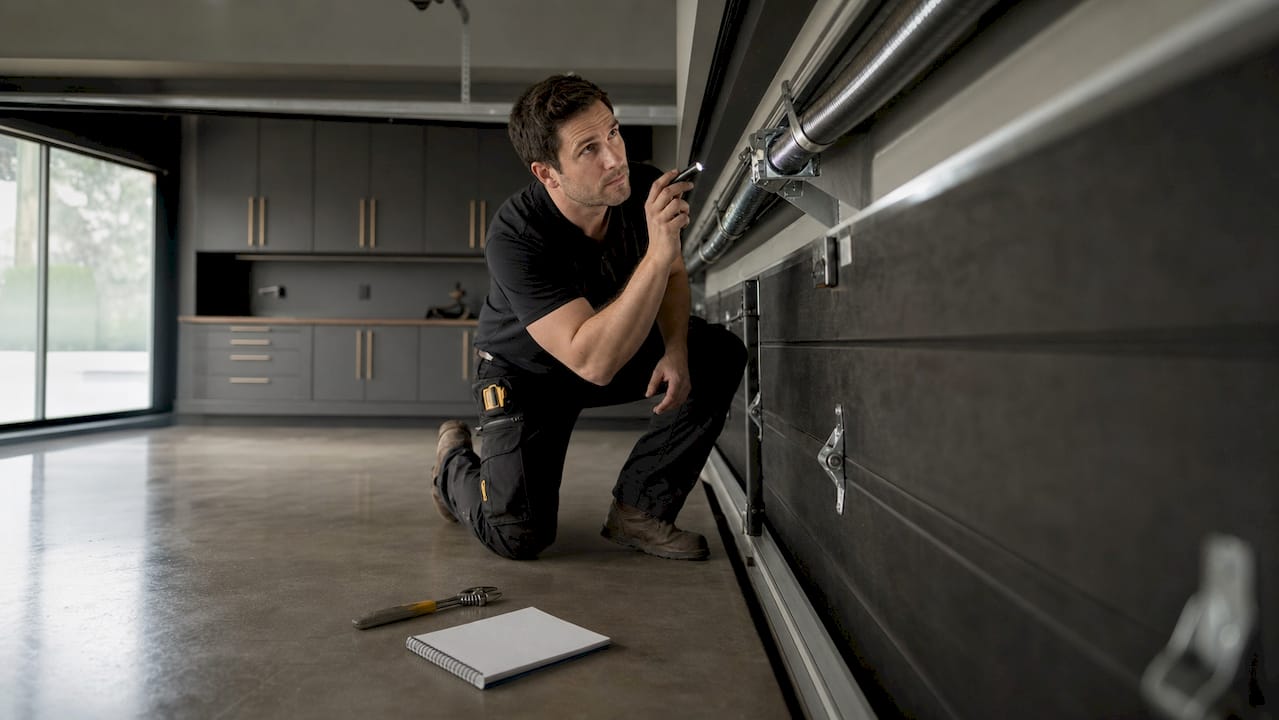
Garage door springs are defined as the counterbalance system that stores and releases mechanical energy to lift and lower your door. The role of garage door springs in operation is more significant than most homeowners realize. Springs do the actual heavy lifting. Your opener just guides the movement. When springs fail, the entire system fails with them, and understanding why helps you catch problems before they become costly emergencies.
How do garage door springs work to make door operation possible?
Springs are the muscle of your garage door system. When you close the door, the springs load up with stored mechanical energy. When you open the door, they release that energy to counterbalance the door’s weight. This exchange is so effective that a 200-pound door can feel like as little as 8 pounds during manual operation. That dramatic reduction in felt weight is what makes it possible for a small motor to move a very heavy object.
Your garage door opener is not doing what you think it is. Springs handle 80–90% of the lifting work, with the opener supplying only about 8 to 15 pounds of force under balanced conditions. That means the opener’s job is closer to a guide rail than a crane. When springs are properly calibrated, the opener barely strains. When springs are weak or broken, the opener works far beyond its design limits.
Here is what happens mechanically during a single open-and-close cycle:
- Door closes: Springs wind up (torsion) or stretch out (extension), storing potential energy.
- Door opens: Stored energy releases, counteracting gravity and lifting the door with minimal motor effort.
- Door holds open: Springs maintain tension to keep the door stable at any height.
- Door closes again: The cycle repeats, and springs reload for the next use.
Pro Tip: Test your door’s balance by disconnecting the opener and lifting the door manually to waist height. A properly balanced door stays put. If it drops or shoots up, your spring tension needs professional adjustment.
What are the types of garage door springs and how do their functions differ?
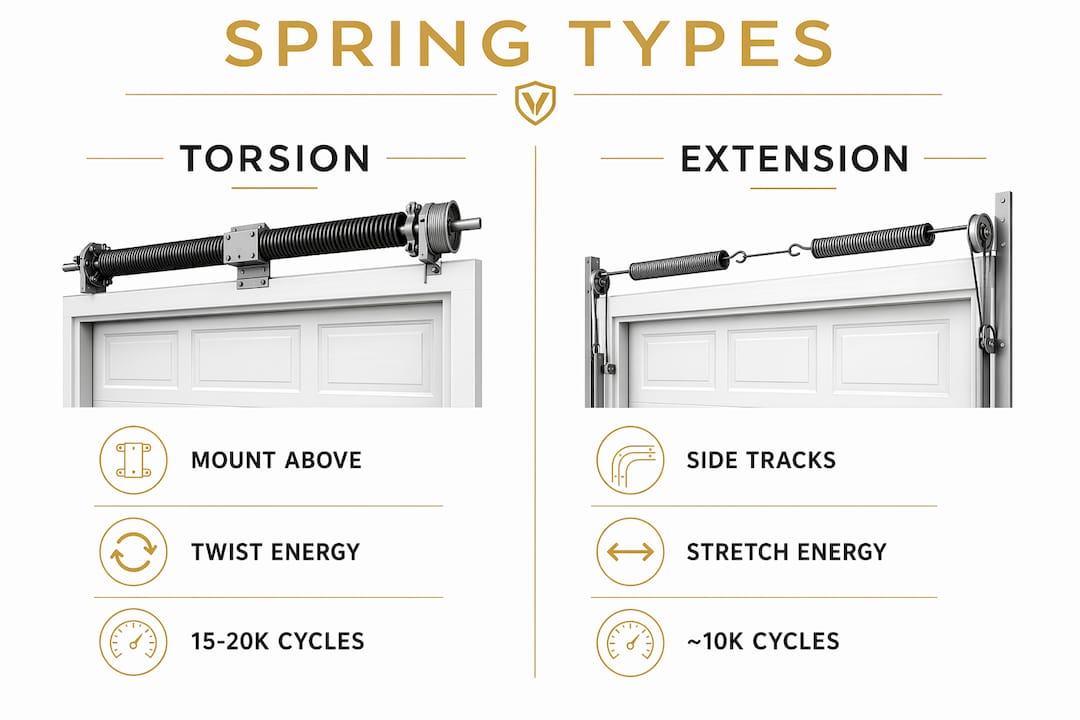
Two spring types handle counterbalancing in residential garage doors: torsion springs and extension springs. They store energy differently, mount in different locations, and carry different safety profiles.
Torsion springs
Torsion springs mount on a metal shaft above the door and store energy by twisting along that shaft as the door closes. When the door opens, the shaft unwinds and transfers that rotational force through cables and drums to lift the door evenly on both sides. This even lift is why torsion springs produce smoother, quieter operation. They are the standard choice for modern residential doors, heavier doors, and any door wider than 10 feet.
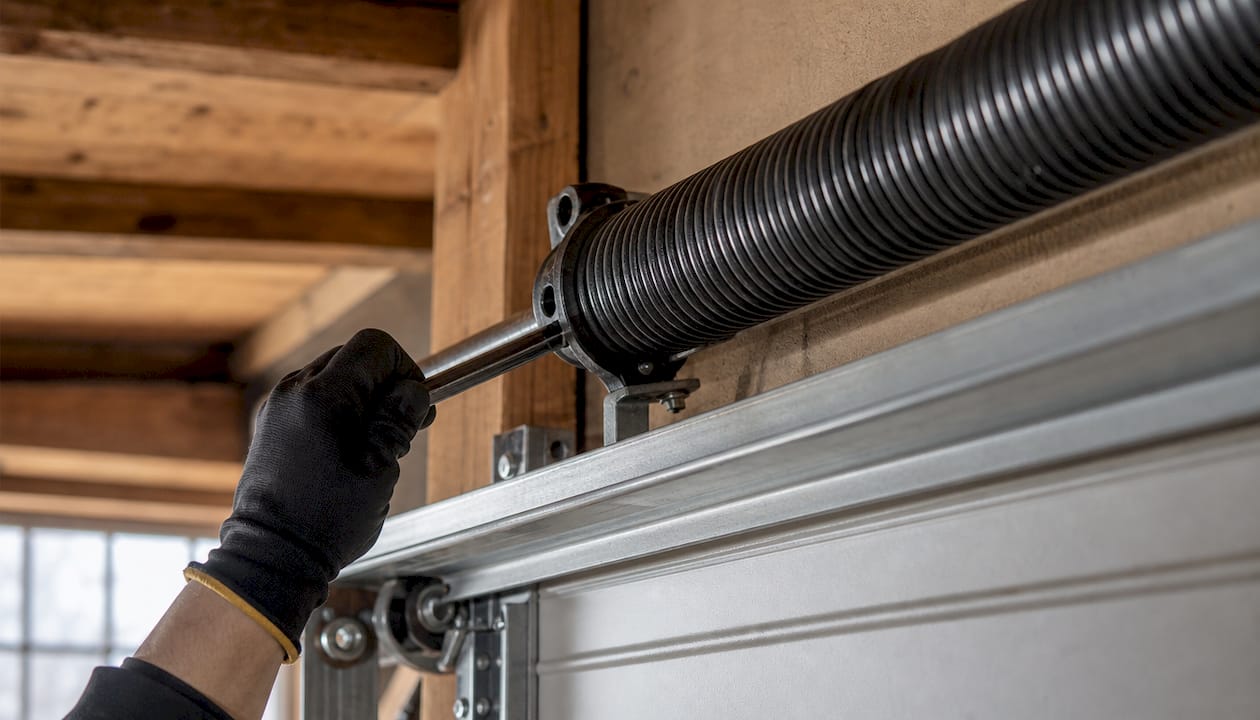
Torsion springs typically last 15,000–20,000 cycles, compared to roughly 10,000 cycles for extension springs. One cycle equals one open and one close. For a household that uses the garage door four times per day, 10,000 cycles represents about seven years of use. Torsion springs at 15,000 cycles stretch that to over ten years under the same conditions.
Extension springs
Extension springs mount along the horizontal tracks on each side of the door. They store energy by stretching as the door closes and contract to release energy when the door opens. You will find them most often on older homes and lighter, single-car doors. They are less expensive to install, but they carry a higher safety risk. A broken extension spring can snap and fly across the garage with significant force. Safety cables threaded through the spring reduce this risk but do not eliminate it.
| Feature | Torsion springs | Extension springs |
|---|---|---|
| Mounting location | Above door on a shaft | Alongside tracks |
| Energy storage method | Twisting | Stretching |
| Typical lifespan | 15,000–20,000 cycles | ~10,000 cycles |
| Operation quality | Smooth and even | Can be uneven |
| Safety when broken | Contained on shaft | Risk of projectile |
| Best for | Modern, heavy doors | Older, lighter doors |
Pro Tip: If your door has extension springs, ask a technician to verify that safety cables are installed and intact. This single addition significantly reduces injury risk if a spring breaks.
How can you recognize signs of garage door spring problems?
Spring failure rarely happens without warning. Knowing the signs of garage door spring failure lets you act before a minor issue becomes a full breakdown. Springs generally require replacement every 7 to 10 years depending on use cycles, so age alone is a useful indicator.
Watch for these warning signs:
- A loud bang from the garage. A breaking torsion spring sounds like a gunshot. If you hear this and your door suddenly stops working, a spring has snapped.
- The door lifts only a few inches, then stops. The opener’s built-in safety feature detects excessive resistance and halts the door. This is often the opener protecting itself from a broken spring.
- Visible gaps in the spring coil. A broken torsion spring separates at the break point, leaving a visible gap in the coil. You can see this by looking at the spring above the door.
- The door feels unusually heavy. If you disconnect the opener and the door feels like dead weight, the springs are no longer counterbalancing properly.
- The door moves unevenly or tilts to one side. This often signals that one spring has failed while the other still functions, creating an imbalanced load.
Ignoring these signs carries real consequences. An out-of-balance door significantly shortens the lifespan of the entire garage door assembly, increasing repair costs across rollers, tracks, hinges, and the opener motor. What starts as a spring problem becomes a system-wide repair bill. You can learn more about why springs break to understand what accelerates this timeline.
What maintenance and safety steps should homeowners follow for garage door springs?
Routine attention to your springs extends their life and protects every other component in the system. A balanced garage door minimizes stress on rollers, tracks, hinges, and the opener motor, extending their useful life. The maintenance steps below are safe for homeowners to perform. Tension adjustment and spring replacement are not.
- Perform a monthly visual inspection. Look at the springs for rust, corrosion, or visible wear. Check the cables for fraying. Look at the hardware for loose bolts or misaligned brackets. A quick two-minute look catches problems early.
- Run the balance test every six months. Disconnect the opener, lift the door manually to waist height, and let go. The door should stay in place. If it drops or rises, the spring tension is off and needs professional correction.
- Lubricate the springs once or twice a year. Apply a garage door lubricant, not WD-40, to the torsion spring coils. This reduces friction, slows rust, and quiets operation. Your full maintenance checklist covers every component in this routine.
- Schedule a professional inspection every one to two years. A trained technician checks spring tension, cable condition, and hardware alignment with calibrated tools. This is the only way to catch tension drift before it causes a failure.
- Never attempt DIY spring adjustment or replacement. A single residential torsion spring stores approximately 236 foot-pounds of energy. That is enough force to cause severe injury in an instant. DIY spring adjustments are a leading cause of injuries in home repair. The risk is not theoretical. Leave tensioning and replacement to a trained garage door professional every time.
Pro Tip: Write the installation date on your springs with a paint marker. When you hit the seven-year mark, schedule a professional inspection even if the door seems fine. Proactive replacement costs far less than an emergency call.
Key Takeaways
Garage door springs do 80–90% of the lifting work in every open-and-close cycle, making their condition the single most important factor in your door’s performance, safety, and long-term cost.
| Point | Details |
|---|---|
| Springs do the real work | Springs handle 80–90% of lifting; the opener provides minimal force under balanced conditions. |
| Two spring types, different risks | Torsion springs last longer and are safer when broken; extension springs need safety cables installed. |
| Failure has clear warning signs | Loud bangs, partial lifting, visible coil gaps, and a heavy door all signal spring problems. |
| Imbalance damages the whole system | A worn or broken spring accelerates wear on rollers, tracks, hinges, and the opener motor. |
| DIY adjustment is dangerous | Torsion springs store extreme energy; always use a trained garage door professional for tension work or replacement. |
What 12 years of spring repairs taught me about homeowner mistakes
After more than a decade working on garage doors across the East Bay, the pattern I see most often is not neglect. It is misplaced confidence. Homeowners hear the door open and assume the opener is doing the work. They service the opener, oil the tracks, and ignore the springs entirely. Then one morning a spring snaps and the door will not budge.
The opener is not the engine of your garage door. The springs are. When I explain to a homeowner that their 200-pound door feels light because the springs are storing nearly 800 foot-pounds of torsional stress, the look on their face changes. That is not a minor mechanical detail. That is the entire system working correctly, and it deserves the same attention you give your HVAC or your roof.
The second mistake I see is the YouTube repair attempt. I understand the impulse. Spring replacement looks straightforward on video. But those videos do not show the emergency room visits. Standard torsion springs store enough energy to cause serious injury, and many DIY-related injuries happen from improper spring handling each year. The tool required to wind a torsion spring is a winding bar, and if it slips, the consequences are immediate and severe.
My honest advice: inspect visually, test the balance, and call a professional for everything else. That boundary keeps you safe and keeps your door running for years longer than it would otherwise.
— Val
Trusted spring repair and replacement from Valiantdoor
When your garage door shows signs of spring trouble, the right call is a professional who knows the system from the inside out.

Valiantdoor has served homeowners in Pleasanton and across the East Bay for over 12 years, with founder-led spring repair and replacement backed by live customer reviews and same-day availability. Whether you have a snapped torsion spring, an unbalanced door, or a system that has not been inspected in years, Valiantdoor provides transparent diagnostics and quality workmanship on every job. For urgent situations, emergency garage door repair is available when you need it most. Your springs carry the weight of your door every single day. Trust a technician who takes that responsibility seriously.
FAQ
What is the main role of garage door springs?
Garage door springs counterbalance the door’s weight by storing mechanical energy when the door closes and releasing it to lift the door when it opens. This process reduces the effective weight of the door so the opener requires minimal force to operate.
How long do garage door springs typically last?
Torsion springs last approximately 15,000–20,000 cycles, while extension springs last around 10,000 cycles. For most households, this translates to 7–15 years depending on how frequently the door is used.
Can I replace garage door springs myself?
Spring replacement is not a safe DIY task. A single torsion spring stores approximately 236 foot-pounds of energy, and improper handling causes serious injuries. Always hire a trained garage door professional for spring replacement or tension adjustment.
What are the warning signs of a failing garage door spring?
The most common signs include a loud bang from the garage, the door lifting only a few inches before stopping, visible gaps in the spring coil, and the door feeling unusually heavy when lifted manually.
How do torsion springs differ from extension springs?
Torsion springs mount above the door on a shaft and store energy by twisting. Extension springs mount along the side tracks and store energy by stretching. Torsion springs last longer, operate more smoothly, and are safer when they break because they stay contained on the shaft.