


The role of garage door in energy efficiency is defined by its position as the largest moving thermal boundary in most homes. An attached garage door directly influences how much heat enters or escapes your living space, and the numbers are significant. Insulating an attached garage can reduce overall heating and cooling energy consumption by 10%–20%. The U.S. Department of Energy estimates that garage insulation alone can cut home energy costs by up to 15%. Most homeowners spend time and money on attic insulation and window upgrades while the garage door, which may span 8–16 feet wide, sits uninsulated and leaking conditioned air year-round.
How garage doors affect energy efficiency through insulation and air sealing
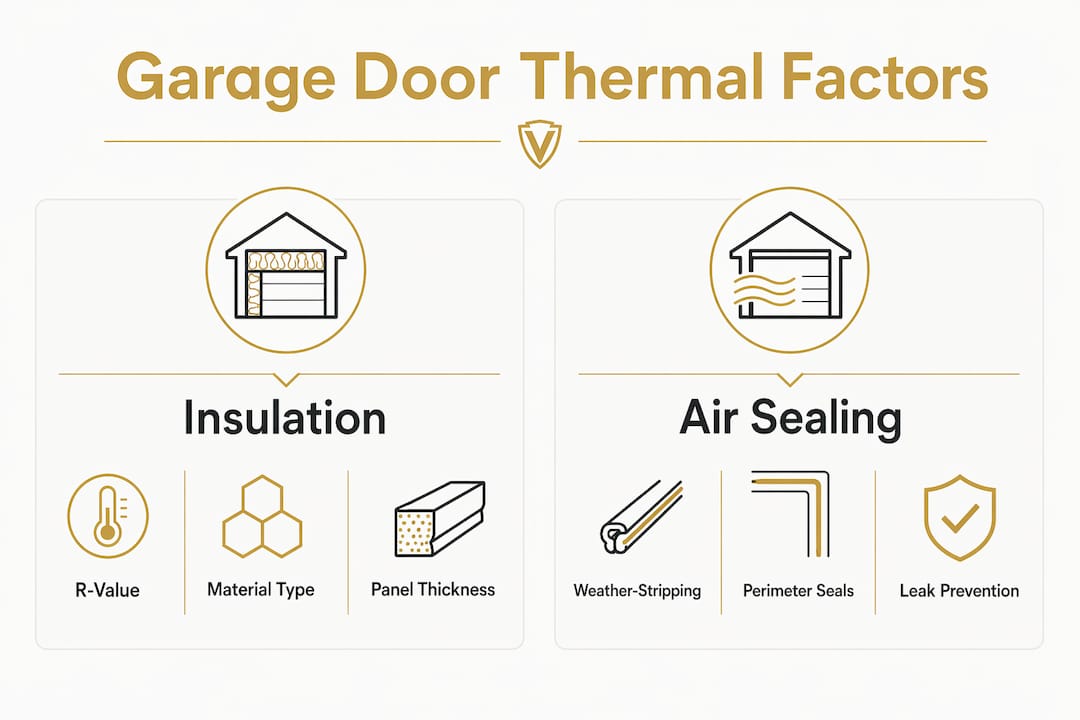
The thermal performance of a garage door depends on two factors: its insulation value and its ability to block air movement. Neither works without the other.

Understanding R-value in garage doors
R-value measures a material’s resistance to heat flow. The higher the R-value, the slower heat moves through the door. Garage doors typically carry R-values ranging from R-0 for bare steel panels to R-18 or higher for premium insulated models. A door rated R-16 transfers heat roughly eight times more slowly than an uninsulated door.
The catch is that the rated panel R-value is not the same as the effective R-value. Hinge joints, gaps at the perimeter, and poor weather-stripping all create thermal bridges that reduce real-world performance. Professional installation closes these gaps and preserves the door’s rated performance.
Polystyrene vs. polyurethane insulation
Two insulation materials dominate the market, and they perform very differently.
- Polystyrene (EPS/XPS): Rigid foam boards inserted between door panels. Less expensive, but the boards can shift over time and leave air gaps between the foam and the steel skin.
- Polyurethane: Foamed in place between the door skins during manufacturing. It bonds directly to the steel, eliminates convective air pockets, and adds structural rigidity. Polyurethane doors typically rate R-13 to R-22, outperforming polystyrene at equivalent thickness.
The 2024 International Energy Conservation Code (IECC) updates favor polyurethane construction because its effective R-value stays closer to its rated value over time.
The role of weather-stripping and perimeter seals
Weather-stripping is the rubber or vinyl seal running along the bottom, sides, and top of the door frame. When it wears out, conditioned air escapes freely regardless of how well the panels are insulated. An insulated door with failed seals performs no better than an uninsulated one.
An insulated garage door keeps an unheated garage approximately 10–12°F warmer in winter and up to 25°F cooler in summer compared to an uninsulated model. That temperature buffer directly reduces the load on your home’s heating and cooling system.
Pro Tip: When comparing doors, ask for the “effective R-value” or “system R-value,” not just the panel rating. A door with R-18 panels and poor perimeter seals can deliver less real-world performance than a well-installed R-12 door with quality weather-stripping.
What R-value does your garage door actually need?
Selecting the right insulation level depends on your climate zone, how the garage connects to your home, and how you use the space.
R-value recommendations by climate zone and garage use
Energy code requirements increasingly treat garage doors as part of the home’s conditioned thermal envelope, which means the old practice of ignoring garage door insulation no longer meets current standards in many jurisdictions.
| Climate Zone | Typical Location | Recommended R-Value | Notes |
|---|---|---|---|
| Zones 1–3 | Southern states, coastal California | R-6 minimum | Warm climates, unconditioned garages |
| Zones 4–5 | Mid-Atlantic, Pacific Northwest | R-10 to R-13 | Mixed climates, moderate heating loads |
| Zones 6–8 | Northern states, mountain regions | R-16 to R-18 | Cold climates, conditioned or adjacent garages |
| Any zone | Workshop or living space above | R-16 minimum | Usage drives insulation need regardless of climate |
Pleasanton and the East Bay fall within a mild climate zone, but garages attached to living space still benefit from R-10 or higher because the shared wall conducts heat in both directions. If you use your garage as a workshop, store temperature-sensitive equipment, or have a bedroom above it, treat it like conditioned space and select accordingly.
Pro Tip: Check your local jurisdiction’s adoption of IECC 2024 before purchasing a replacement door. Some California counties have adopted stricter requirements than the base code, and a door that met code in 2020 may not qualify for energy rebates today. Valiantdoor’s team can confirm current local requirements during a site assessment.
How garage use changes the calculation
A garage used purely for parking needs less insulation than one that doubles as a workshop. Heat generated by power tools and people creates a temperature differential that drives more heat loss through an uninsulated door. The IECC 2024 code updates specifically address garages adjacent to conditioned living space, requiring higher minimum R-values in those configurations.
Why air leakage undermines even the best insulated garage door
Insulation stops conductive heat transfer. Air sealing stops convective heat transfer. You need both. Most homeowners focus on the first and ignore the second.
The chimney effect in garages
Air leakage through worn seals creates a “chimney effect” in attached garages. Warm air rises and escapes through gaps at the top of the door frame. Cold air rushes in at the bottom to replace it. This cycle runs continuously, pulling conditioned air from your home through the shared wall and replacing it with outdoor air. A high R-value door panel does nothing to stop this movement.
Signs your garage door is leaking air
Watch for these indicators during your next inspection:
- Visible daylight around the door frame when the door is closed
- Cold drafts at floor level near the garage entry door into your home
- Frost or condensation on the interior face of the door panels in winter
- Uneven temperatures between the garage and adjacent rooms
- Worn, cracked, or compressed weather-stripping that no longer makes full contact with the door frame
Homeowners commonly overlook air leakage as the primary factor reducing the effectiveness of even high-R-value doors. Replacing weather-stripping is one of the lowest-cost, highest-return maintenance tasks available.
Maintenance routine to sustain thermal performance
A twice-yearly inspection covers the most critical points. Check the bottom seal for cracks or compression set. Run your hand along the side and top seals with the door closed to feel for drafts. Inspect the door panels for dents or gaps that break the insulation layer. A consistent maintenance schedule prevents small seal failures from becoming large energy losses.
Benefits beyond the energy bill: comfort, noise, and home value
Energy savings are the headline benefit of an insulated garage door, but they are not the only one. The same properties that reduce heat transfer also improve daily life in ways that show up immediately.
Year-round comfort and temperature stability
A garage that stays 10–12°F warmer in winter is a garage you can actually work in. Tools don’t freeze. Paint doesn’t separate. Cars start more reliably. The temperature buffer also reduces the thermal shock your home’s HVAC system experiences every time the garage door opens, which extends equipment life.
Noise reduction and structural strength
Insulation dampens noise by adding mass and absorbing sound waves. A polyurethane-filled door significantly reduces street noise, wind noise, and the mechanical sound of the door itself operating. The foam also bonds the door’s steel skins together, making the panel more rigid and resistant to denting.
Home resale value and curb appeal
Quality garage doors consistently rank among the highest-return home improvement projects in annual cost-versus-value studies. An insulated door with a clean, modern profile improves curb appeal and signals to buyers that the home has been maintained with attention to detail. Buyers increasingly ask about energy efficiency features, and a documented upgrade to an insulated door with quality seals is a concrete answer.
Key Takeaways
An insulated, properly sealed garage door is one of the most cost-effective thermal upgrades available to homeowners with attached garages.
| Point | Details |
|---|---|
| Insulation reduces energy costs | Attached garage insulation cuts heating and cooling consumption by 10%–20%. |
| R-value selection matters | Match R-value to climate zone: R-6 minimum for warm climates, R-16 to R-18 for cold. |
| Effective R-value differs from rated | Hinge joints and worn seals reduce real performance; professional installation closes the gap. |
| Air sealing is non-negotiable | The chimney effect from leaky seals undermines even high-R-value doors. |
| Benefits extend beyond savings | Insulated doors reduce noise, protect stored items, and improve home resale value. |
What 12 years of garage doors taught me about energy efficiency
The conversation about energy-efficient garage doors almost always starts with R-value and almost always misses the point. Homeowners come in asking for the highest R-value door they can afford, and I understand the instinct. But I’ve seen R-18 doors installed with a bottom seal that doesn’t make full contact with an uneven concrete floor, and they perform worse than a well-maintained R-10 door with a fresh perimeter seal.
The mistake I see most often is treating the door as an isolated product rather than part of a system. The door, the frame, the weather-stripping, and the floor seal all work together. A weak link in any one of them collapses the whole thermal barrier. I’ve walked into garages in january where you could feel a steady cold draft at ankle height, and the homeowner had no idea it was happening because the door itself looked fine.
My honest advice: before you spend money on a new door, spend 10 minutes with a flashlight checking your current seals. If daylight is visible around the frame, fix the seals first. If the door is more than 15–20 years old, the panels themselves may have lost insulation integrity. At that point, a full door replacement makes more financial sense than patching an aging system.
The other thing I’d tell you is to pay attention to the 2024 IECC changes. Codes are moving toward treating the garage as part of the conditioned envelope, and that shift will affect what qualifies for rebates and what passes inspection on a home sale. Getting ahead of that now, rather than scrambling during a transaction, is the smarter move.
— Val
Valiantdoor’s approach to energy-efficient garage door upgrades
Your garage door’s thermal performance starts with the condition of what’s already installed. A worn seal or a door past its service life costs you money every month in wasted energy.

Valiantdoor serves homeowners across Pleasanton and the East Bay with professional repair and replacement services focused on restoring and improving thermal performance. Whether your current door needs new weather-stripping, a bottom seal replacement, or a full upgrade to a polyurethane-insulated model that meets current IECC standards, the Valiantdoor team brings over 12 years of hands-on experience to every job. Schedule a garage door maintenance assessment to find out exactly where your door is losing energy and what it will take to fix it.
FAQ
How much energy can an insulated garage door save?
An insulated garage door on an attached home can reduce heating and cooling energy consumption by 10%–20%, with the U.S. Department of Energy citing up to 15% in home energy cost reductions.
What R-value should I choose for my garage door?
R-6 is the minimum for warm climates in Zones 1–3, while cold climates in Zones 6–8 require R-16 to R-18. Garages adjacent to living space or used as workshops need at least R-16 regardless of climate zone.
Is polyurethane insulation better than polystyrene in garage doors?
Polyurethane is foamed directly into the door panel, bonding the steel skins and eliminating air pockets. This gives it a higher effective R-value and greater structural strength compared to polystyrene board inserts.
Can air leakage cancel out my door’s insulation?
Air leakage through worn seals creates a chimney effect that continuously pulls conditioned air out of your home. This convective loss operates independently of panel R-value and can eliminate most of the thermal benefit from even a well-insulated door.
How often should I inspect my garage door seals?
A twice-yearly inspection, once before winter and once before summer, catches seal wear before it becomes significant energy loss. Look for visible daylight around the frame, drafts at floor level, and cracked or compressed weather-stripping.