

Problem library
Broken Garage Door Cable
Lift cables are the quiet workhorses of a garage door. They are also the part most likely to fail without warning, and a failed cable usually announces itself with a door that suddenly hangs crooked.
What The Cables Actually Do
Each side of your door has a steel cable running from a bracket at the bottom corner up to a grooved drum at the top of the spring shaft. When the springs unwind, the drums turn and reel the cable in. That is what lifts the door.
Springs supply the force. Cables deliver it. If a cable breaks, the springs are still fully loaded but one side of the door has nothing holding it, so the door drops or twists on that side within a single cycle.
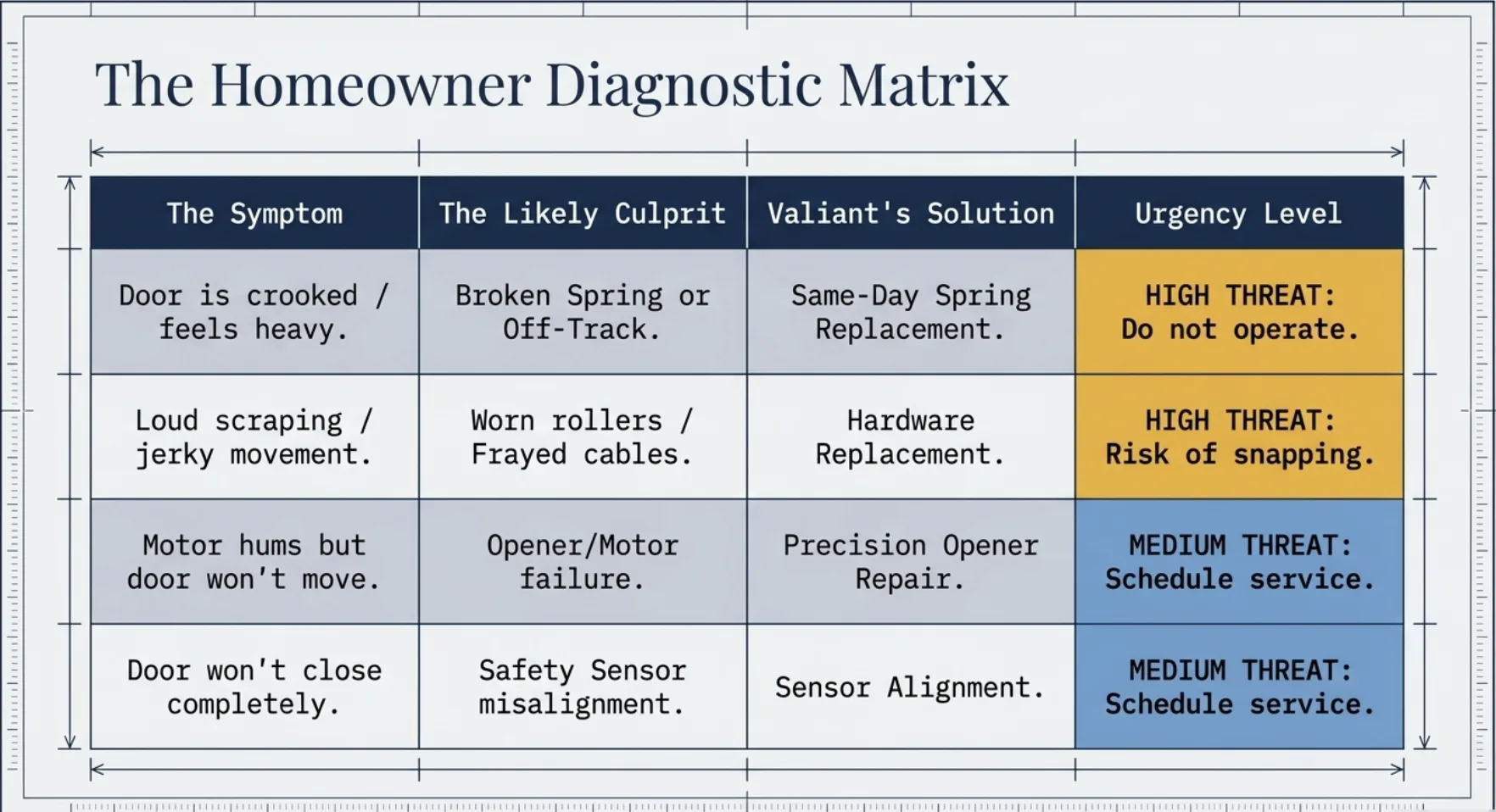
Four Failure Patterns, Four Different Urgencies
| Condition | What you notice | What to do now |
|---|---|---|
| Fraying | Broken wire strands, a fuzzy or barbed section, rust stains | Stop using the door and schedule replacement |
| Slack | One cable loose or looped while the door is closed | Unplug the opener, leave the door down |
| Snapped | A loud pop, then one corner sitting low or the door jammed | Do not operate at all, call for service |
| Off the drum | Cable piled or wedged beside the drum, door crooked | Do not operate, the drum needs re-wrapping |
Fraying is the one you can catch early. The other three have already changed how the door carries its weight.
The One-Sided Lift Test You Can Do By Eye
Stand square in front of the closed door. Look at the gap along the top edge, then look at both bottom corners against the floor. A healthy door is parallel to both.
If one corner sits high or the top edge tilts, one side is being lifted more than the other, and cable or drum trouble is the leading suspect. Do not test it by running the door. A crooked door under power is the exact condition that pulls rollers out of the track, which our off-track guide covers.
Why Cables Fail Here
Cables rarely fail from a single event. They wear out for reasons that are pretty predictable in East Bay garages:
- Water and grit at the bottom bracket, especially where the driveway drains toward the door.
- Rusted or bent bottom brackets that let the cable loop chafe.
- Drums that were never set with matched tension, so one cable does extra work every cycle.
- An out-of-balance spring set, which adds load the cables were not sized for.
- A door that has been off track before and left the cable with a kink.
- Age plus cycles, since a family door can run four to six times a day for a decade.
A Safe Two-Minute Inspection
With the door fully closed and the opener unplugged, stand to the side and use a flashlight. Trace each cable from the bottom bracket up to the drum. You are looking for rust, broken strands, kinks, and whether the cable sits neatly in the drum grooves.
Keep your hands off the cables, the drums, the spring shaft, and the bottom brackets. The bottom bracket is under cable tension even with the door closed. Loosening it is one of the most common ways homeowners get hurt on a garage door. Photograph what you see and let the photos do the reporting.
What A Correct Cable Replacement Looks Like
The door gets clamped or supported so it cannot move. Spring tension is unwound in a controlled way with proper winding bars. Old cables come off, and the bottom brackets and drums get inspected for wear, since a grooved drum will chew a new cable.
New cables of the right length and rating go on as a matched pair. The drums are set so both sides wrap evenly, the springs are wound back to spec, and then the door is tested by hand for level and balance before the opener is reconnected. Last, opener force and travel are checked and the safety reverse is verified.
You can read the full scope on our cable repair page, including how we handle drums and brackets that are past service.
Cables And Springs Are A Package Deal
When a cable comes in for replacement, the spring set is right there and the tension is already off. That is the cheapest moment in the life of the door to deal with a spring that is near the end of its cycle rating.
We will tell you what we see and let you decide. If the springs have years left, we say so. If they are ten years old with visible gapping and rust, replacing them during the same visit avoids paying for a second tension teardown in a few months. Details are on the spring replacement page.
Making Cables Last Longer
Keep the bottom two feet of the door dry. Redirect sprinklers, clear the floor channel where the door meets concrete, and sweep grit away from the brackets. Do not spray heavy grease on cables; it collects dust and hides fraying.
Once a year, have the door balanced and the hardware checked. A door that is properly counterbalanced puts even, predictable load on both cables, and that is what actually buys years.
Cable And Spring Resources
Cable Questions Homeowners Ask
Should both cables be replaced if only one broke?
Yes. Both cables aged under the same load and the same moisture. Matching a new cable against a stretched old one puts the door back out of level, so cables are replaced as a pair.
Why do cables fray at the bottom bracket first?
The bottom loop sits closest to the concrete, where water pools and salt collects. Corrosion starts there, and the constant flex at the loop wears strands until the cable frays. Anything that lets water sit against that bracket shortens cable life.
Can I keep using the door with a slack cable?
No. Slack means one side of the door is unsupported, and the next cycle can pull the door out of its tracks. Unplug the opener and leave the door closed.
Is a cable repair the same as a spring repair?
They are different parts but they share a shaft, drums, and tension. Cables are usually replaced with the springs unwound, so it is common to inspect the spring set at the same visit and mention any remaining life.
Ready For A Clear Next Step?
Call (925) 409-4974, request an appointment, or start an instant estimate with photos.